Posts

Python on the Chumby Hacker Board
Image
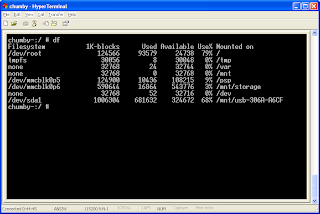
I picked up a couple of Chumby Hacker Board beta units from Adafruit for a project I'm working on, and of course I'm looking to use Python to write my app for the project. Turns out it's not all that tough. I'll skip over the basics of getting your CHB talking to your PC over a serial connection- Adafruit covers that on their wiki page . I will, however, add a note to their method to say that, unless you're planning on doing a vast amount of Chumby hacking, you might be better served making an adapter to connect your FTDI cable to the CHB rather than rejiggering the connector. It's pretty easy- if the CHB header had two pins between RX and GND instead of one, you'd be able to plug it in directly, as the FTDI cable has the pins in the proper order. By the way, I find putty a more palatable terminal program than HyperTerminal for this process, but that's just me. Also, it may be a good idea to install the gcc environment on your board before installi...

OSHW and design tools

Finally, there's some movement towards a unified concept of what "open source hardware" really is. Adafruit has posted their opinion on the matter for some time , and there have even been a couple of attempts to make an actual license to cover it. What prompted this post is a developing sticking point in the issue: design tools. The discussion below references the " Definition of Free Cultural Works " linked to above. In section 1, "Documenation", find the following passage: The documentation must include design files in the preferred form for which a hardware developer would modify the design. There's a lively Twitter debate (140 characters at a time isn't enough)(and I hate clogging the feeds of non-participants) between myself and Adam and Matt of Wayne and Layne about the implications of this statement regarding the tools which can be used to do the development as well as the file formats used to distribute the design. As a burgeo...

Make...stories?

I'm reading Neil Gaiman's wonderful short fiction anthology, "Fragile Things", and one of his stories in there is his only personal ghost story, "The Flints of Memory Lane". It reminded me so starkly of MY only personal ghost story that I think I have to get it down. I've not told it, or even thought of it, in years, but perhaps I can do it justice... The thing about seeing something vanish, really disappear, is how subtle it is. I know, that sounds weird- some bleeding great big THING looming in front of you, gone, poof, like a fart in the wind (except it's your eyes and not your nose that are fooled), and you'd think subtle is the last word one would use to describe it, but there it is. It's funny, actually- I don't really remember how old I was at the time. I can guess- somewhere between 14 and 17, because I was only out at the park for the six summers between when I was 14 and 20, and I clearly remember that I was in high school at...

Qtouch libraries

I'm so down with Atmel's Qtouch library . Basically, it lets you add capacitive touch detection to your projects- and it works through non-conductive surfaces. Think touch-sensitive sealed keypads, or the scroll wheel from the older generation of iPods. Nobody- as near as I can tell- has this working with the Arduino environment yet. It should be doable, because you can do it in AVRStudio compiling code through WINAVR, which is just a distribution for AVR-GCC, which is what Arduino compiles its code with. I'm working on it, but here, in the meantime, is a walk-through of getting the Qtouch demos working with the '328P found on the Arduino board (under Windows- don't bug me about figuring out how to use it in Linux): 1. Download and install AVRStudio from Atmel- annoyingly, you have to fill in a long-ish form with the standard information about who you are and what you're doing. This is not, in and of itself, TOO annoying- but the fact that they make you d...

Omnidirectional wheels for bots

Image
Woot! had a neat WowWee RC vehicle on the other day, and I sent a link to a coworker thinking he might dig the locomotion system (he's a mechanical engineer, but an okay guy nonetheless). Five minutes later, he shows up at my desk with this: He'd bought it years before, for no particular reason. He dug a bit and found a website that sells it , $9 a pop. Yet another really cool item I'll never get to use in a project.

Viewing binary data as an image

So, I have a stream of data from a FireWire device I need to interpret as an image. I'll not get into the how or why of this, but the problem is pretty simple: take a file which is 250,848 bytes long, with each byte representing the 8-bit grayscale intensity of a single pixel in a 536 x 458 pixel image, and reconstruct that image. Turns out, finding an app to do this is a non-trivial problem. Sure, I could write something to do it (in the past, I've written a Scilab script that plots it, but that takes a lot of memory, runs slowly, and generally gives me few or no tools to deal with the "image" resulting, besides my eyes), but I KNOW this is a solved problem (my favorite term of late) and anything I came up with would likely be a south-pointing chariot. In the end, I turned to my old friend, ImageJ . ImageJ is a powerful, free, Java-based image manipulation and analysis tool. It's no replacement for GIMP or Photoshop, but it provides a very simple interface to...

Did you see a sign on my door that says "Dead capacitor storage"?

With apologies to Quentin Tarantino... For a 10-year-old problem, the capacitor plague has been bizarrely present in my life recently. It started a couple of weeks ago when a coworker offered me an LCD TV that was "flaky" as scrap (my scraphound predilections are by now legend among those who know me). Being the upstanding gent I am, I pointed out that it was probably bad caps, and I found and replaced the buggers for him. A friend in Iowa sent me an e-mail, asking for help debugging a dead plasma he'd been gifted. He hasn't found bad caps yet but I'm fairly confident he will. My PC was dead the other morning, when I got to work. Guess why? A couple of months ago, I found a dead 17" LCD in the trash bin at the office. By now you should know how I fixed it. A tweep I follow posted this article this morning. This is fascinating for me in that it hits a number of points that people fail to understand about electronics: They wear out, but certain component...